
Diagnostic ultrasound in Malmö
– for muscles, tendons and joints
A thorough assessment is the first step towards the right treatment and rehabilitation.

Jonathan Bengtsson
Osteopath B.Sc Hons DO, qualification in MSK diagnostic ultrasound
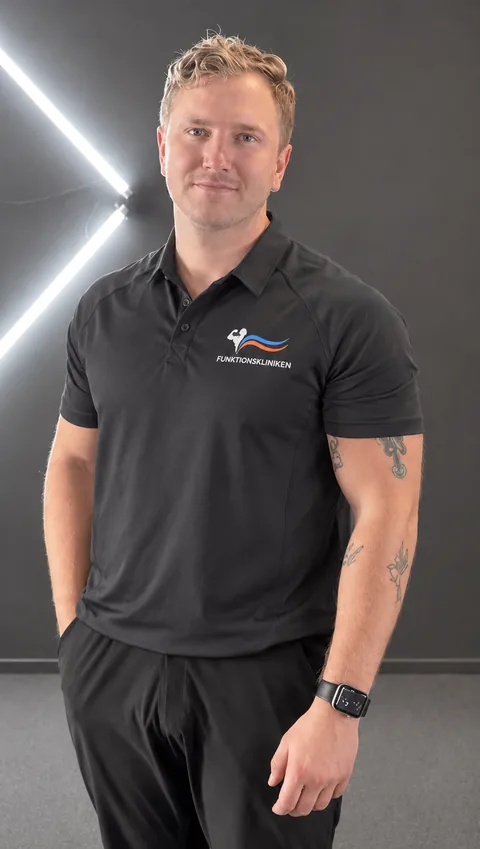
Ludvig Omdal Persson
Registered Physiotherapist, qualification in MSK diagnostic ultrasound
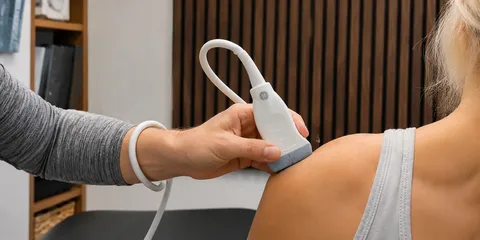
At Funktionskliniken, we offer diagnostic ultrasound (MSK ultrasound) to examine injuries and problems affecting muscles, tendons, ligaments and joints.
Ultrasound is a valuable complement to clinical examination and helps us gain a clearer picture of what may be causing your symptoms. The method is particularly useful in sports medicine, but is also suitable if you have persistent pain or recurring load-related problems.
What can we examine?
With ultrasound, we can assess areas including:
- Muscle injuries – for example, tears in the thigh and calf muscles.
- Tendon injuries – for example, problems affecting the Achilles tendon, patellar tendon and the shoulder’s rotator cuff.
- Joint and ligament injuries – for example, certain ligament injuries, joint fluid and inflammation.
- Other soft tissue conditions – for example, bursae, ganglion cysts and certain nerve-related problems.
Common conditions we examine
Ultrasound is designed to assess soft tissue throughout the body. Below are examples of common conditions we examine, area by area:
- Shoulder – conditions affecting the rotator cuff tendons (e.g. the supraspinatus tendon), calcific tendinitis, bursitis and biceps tendon complaints.
- Elbow – tennis elbow (lateral epicondylitis) and golfer's elbow (medial epicondylitis).
- Hand and wrist – de Quervain's disease, ganglion cysts, inflammation of tendons and tendon sheaths, and assessment of certain nerve-related conditions.
- Hip and groin – trochanteric bursitis (GTPS), hip flexor tendon complaints, adductor tendon problems and groin injuries in athletes.
- Knee – jumper's knee (patellar tendinopathy), Osgood-Schlatter and Sinding-Larsen-Johansson in young athletes, Baker's cyst, bursitis as well as joint and ligament complaints.
- Lower leg, foot and ankle – Achilles tendon conditions (tendinopathy and partial ruptures), plantar fasciitis (heel spur), Morton's neuroma, the peroneal tendons, ligament injuries after ankle sprains and muscle tears in the calf and thigh.
What happens during the examination?
We begin by listening to the history of your symptoms and carrying out a clinical examination. We then use ultrasound to examine the affected area in more detail if needed.
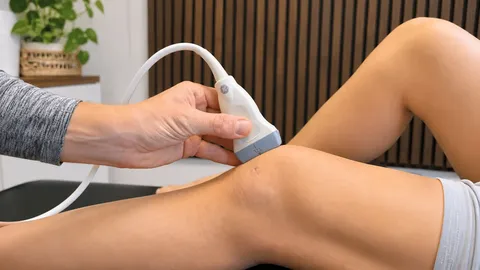
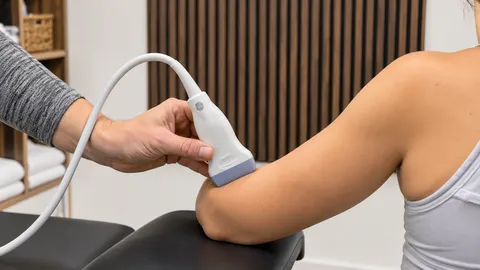
One advantage of ultrasound is that we can examine tissues in real time and during movement. The examination is usually painless and involves no radiation.
Afterwards, we review the results together and provide recommendations for treatment, rehabilitation or any further investigations.
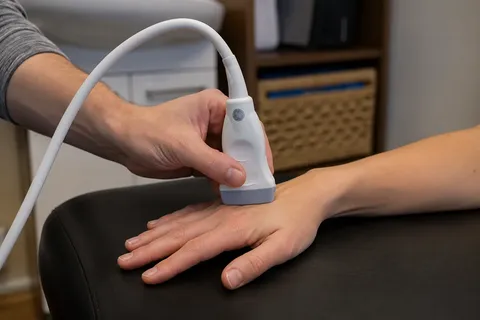
Ultrasound for sports injuries
For those who take part in sport, ultrasound can be particularly valuable for suspected muscle tears, tendon injuries and overuse problems.
By combining ultrasound with clinical tests and functional assessment, we can provide a better basis for personalised rehabilitation and a safe return to sport.
Ultrasound at Funktionskliniken
At our clinic, examinations are performed by Jonathan Bengtsson and Ludvig Omdal Persson, with a focus on musculoskeletal diagnostics and sports medicine conditions.
Ultrasound cannot identify every type of injury and does not always replace other investigations, such as MRI or X-rays. We therefore always base our approach on an overall clinical assessment.
Advantages compared with other imaging methods
| Method | Advantages | Limitations |
|---|---|---|
| Ultrasound | Fast, inexpensive, dynamic, no radiation | Difficult to assess deep structures |
| X-ray | Good for bones and fractures | Does not show soft tissue |
| MRI | High level of detail for soft tissue | Expensive, long waiting times, not dynamic |
Our aim is for you to understand your condition and receive the right help to return to an active daily life with good function.
Frequently asked questions
We offer diagnostic ultrasound (MSK ultrasound) to examine injuries and problems affecting muscles, tendons, ligaments and joints. This method is a valuable complement to the clinical examination and is particularly useful in sports medicine, but is also suitable for people with persistent pain or recurring load-related problems.
Muscle injuries, such as tears in the thigh and calf. Tendon injuries, such as conditions affecting the Achilles tendon, patellar tendon and shoulder rotator cuff. Joint and ligament injuries, such as certain ligament injuries, joint effusion and inflammation, as well as other soft tissue conditions involving bursae, ganglion cysts and certain nerve-related conditions. We also examine common diagnoses such as tennis elbow, golfer's elbow, Achilles tendon problems, plantar fasciitis (heel spur), jumper's knee, Morton's neuroma and conditions affecting the shoulder, hip and groin.
We begin by listening to the history of your symptoms and carrying out a clinical assessment. We then examine the affected area in more detail using ultrasound. Afterwards, we discuss the findings with you and provide recommendations for treatment, rehabilitation or any further investigations.
No, the examination is usually painless and involves no radiation. One advantage of ultrasound is that we can examine tissues in real time and during movement.
No. Ultrasound cannot identify every type of injury and does not always replace other examinations, such as MRI or X-rays. We therefore always base our approach on a comprehensive clinical assessment.
No, you do not need a referral. You can book directly using the "Book an appointment" button on the page.
Book your ultrasound examination at Funktionskliniken in Malmö.
Price and visit length
Diagnostic ultrasound & orthopaedic assessment – first visit
45 min · 1300 kr
Book this appointmentDiagnostic ultrasound & orthopaedic assessment – follow-up
30 min · 700 kr
Book this appointment